


Sometimes it's a dull ache. Sometimes the first sign is infertility.
Most men with a varicocele feel nothing at all.1 For the rest, it shows up as an ache that worsens with standing or exercise, a heaviness in the scrotum, low energy and reduced strength from falling testosterone2,6 — or as a low sperm count discovered only after months of trying to conceive.5
What a varicocele can feel like
Most men have none — but when symptoms come, these are the patterns.
Of varicoceles cause pain1
Of men evaluated for infertility have one4
Can fall — affecting energy & strength2,6
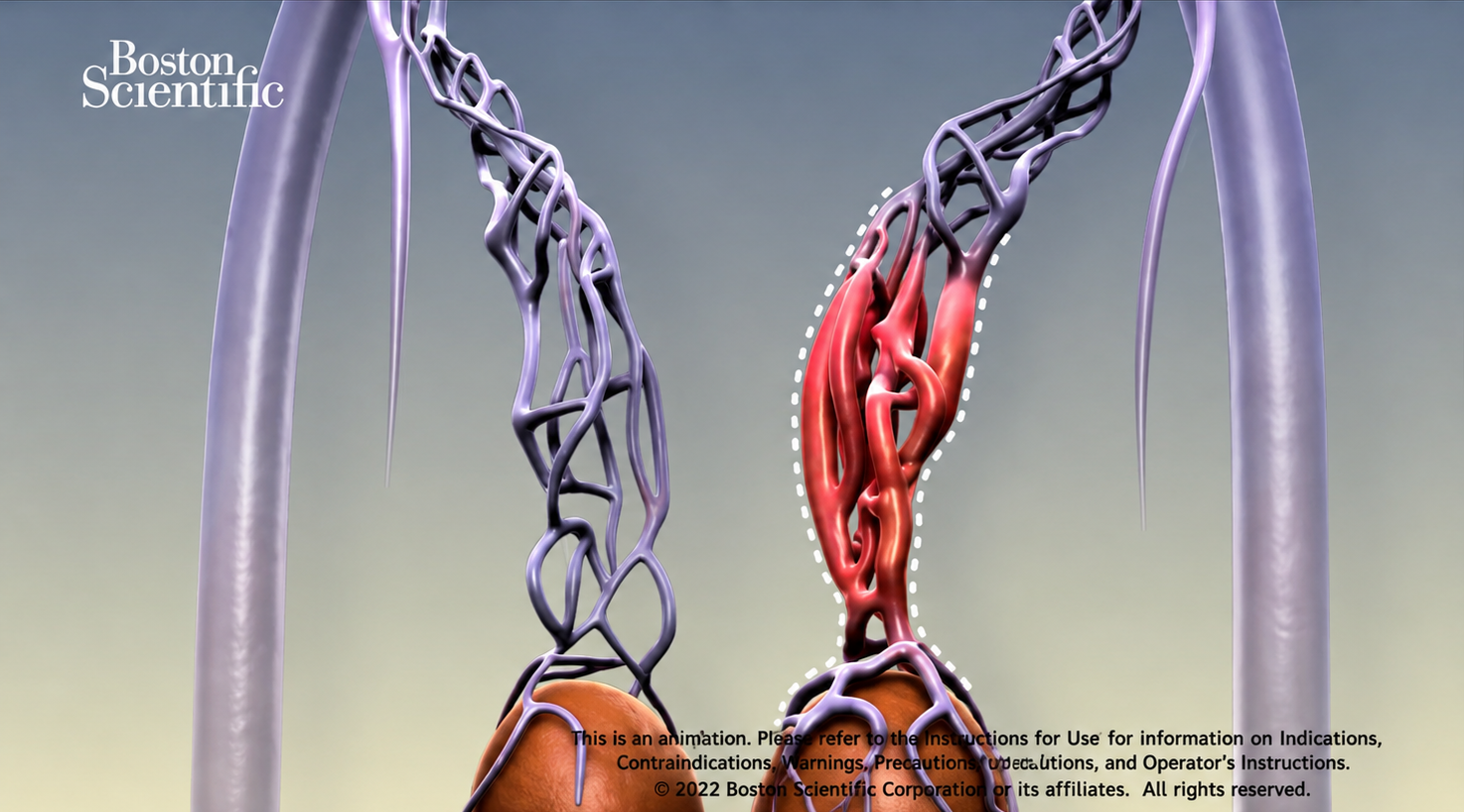
Most men do not have any symptoms — the varicocele is an incidental finding on physical examination.1 When symptoms do occur, the usual pattern is a dull pain or aching of the affected testicle, worse with certain activities or exercise, and at its most severe felt at the end of the day or after prolonged standing. Some men describe heaviness in the scrotum; others feel a mass or enlargement. Abnormal flow can also lower testosterone — affecting sexual function, strength and energy2,6 — and over time can cause shrinkage of the testicle.7 In some men there is no pain at all, and the varicocele is only found after failed attempts at conception: the abnormal blood flow lowers sperm count and alters sperm movement and structure.5
A “bag of worms” feel
What are the symptoms of a varicocele?
Most men have no symptoms at all. When symptoms occur, it's usually a dull ache that worsens with activity, exercise, or a long day on your feet.1
Most men do not have any symptoms, and the varicocele is an incidental finding discovered on physical examination. For a minority of men, however, this can pose more of an issue — published estimates put the prevalence of pain associated with varicoceles at around 2% to 10%.1
If symptoms occur, it usually presents with dull pain or aching of the affected testicle. This can be worse with certain activities or exercise. If severe, patients can feel discomfort even at the end of day or standing for a prolonged period. Some patients describe their symptoms as heaviness in the scrotum, while others it feels like a mass or enlargement of the affected testicle.
Common, but not always a problem. Varicoceles are found in roughly 15% of the general male population.3 Having one does not automatically mean it needs treatment — what matters is whether it is causing symptoms, affecting fertility, or affecting testicular growth.4
Find out in under a minute - no phone call needed
Pain, hormones, or fertility — and sometimes only one of them
A varicocele doesn't present the same way in every man. These are the three patterns we see — and the third one causes no pain at all.
Pain & heaviness
A dull ache in the affected testicle, worse with exercise, activity, or a long day standing. Heaviness in the scrotum, or the feeling of a mass.
Low testosterone effects
Reduced strength, low energy, and effects on sexual function — traced back to abnormal flow around the testicle affecting testosterone production.2,6
Infertility — with no pain
No discomfort at all. The varicocele is found only after failed attempts at conception, when semen analysis shows a low count or abnormal sperm.5
Can a varicocele affect testosterone and energy?
Yes. Abnormal flow around the testicle can affect testosterone production — interfering with sexual function and causing reduced strength and low energy.2
Abnormal flow around the testicle can also affect testosterone production. This can not only interfere with sexual function but also result in reduced strength and low energy.2
This is one of the less-discussed effects of a varicocele, and it is often the one men notice without connecting it to the cause. A prospective controlled study found that men with clinical varicoceles had lower baseline serum testosterone than men without them, and that testosterone improved after varicocele repair — with the greatest gains in men whose levels were low to begin with.6
Can a varicocele cause the testicle to shrink?
Yes — over time a varicocele can cause shrinkage of the testicle, leaving one or both smaller than normal.
Over time a varicocele can also cause shrinkage of the testicle, leading to one or both testicles to be smaller in size than normal.
When infertility is the first sign
For some men pain is never the symptom. The varicocele is discovered only after failed attempts at conception.
In other patients, pain may not be the primary symptom but rather infertility. After failed attempts at conception it is discovered that they have a varicocele. This abnormal blood flow results in a lower sperm count and abnormal movement and structure of the sperm.5
The scale of this is easy to underestimate. While varicoceles are present in roughly 15% of all men,3 they are found in approximately 40% of men presenting with infertility — which is why varicocele remains the most common correctable cause of male infertility.4 A systematic review and meta-analysis using WHO criteria confirmed the pattern: men with varicoceles show measurably poorer semen parameters, including sperm concentration, motility and morphology.5
If you've been trying without success, a varicocele is one of the few causes of male infertility that can actually be corrected — and it can be treated without surgery. See how a varicocele is diagnosed →
Should I seek treatment?
If your varicocele is causing any of these symptoms, you may be a candidate. Surgery is not your only option.
If you have a varicocele resulting in any of the above symptoms, then you may be a candidate for treatment. Surgery is not your only option. Non-surgical embolization results in faster recovery, less risk and can be performed without any stitches or major incisions.8
Am I a candidate for varicocele embolization?
Treatment is offered for males who have:
- Fertility problems (problems fathering a child)4
- Pain1
- Boys with a smaller testicle; at a higher risk for fertility problems when they are older4
What is varicocele embolization?
How is non-surgical embolization performed?
Twilight sedation, a numbed pinhole, a tiny catheter, foam and coils — then a Band-Aid.
Symptoms are the easy part. Treating them well is not.
Sealing the right veins and sparing the healthy ones is precision work — read entirely from flat images of a three-dimensional venous system, in real time.
Some skills can't be taught — only sharpened
Embolization is done through a pinhole, guided entirely by X-ray: a flat, two-dimensional picture of a three-dimensional venous system. The physician has to hold that anatomy in his head, thread a hair-thin catheter through it, and place coils exactly where they will hold — sealing only the refluxing veins while leaving healthy drainage intact. That spatial ability is an innate talent that comes easily to very few: experience sharpens it, but it can’t manufacture it. Our specialist is dual board certified in diagnostic imaging and interventional radiology, with over 2,000 complex embolizations across more than 10,000 image-guided procedures — so the images that confirm your diagnosis are read by the same physician who acts on them.
Dual board certified in imaging — the ultrasound can be performed and interpreted in our office, not read off someone else’s report.
Request an Appointment
Please note that although we strive to protect and secure our online communications, and use the security measures detailed in our Privacy Policy to protect your information, no data transmitted over the Internet can be guaranteed to be completely secure and no security measures are perfect or impenetrable. If you would like to transmit sensitive information to us, please contact us, without including the sensitive information, to arrange a more secure means of communication. By submitting this form you consent to receive text messages from CVI at the number provided. Msg & data rates may apply. Msg frequency varies. Unsubscribe at any time by replying STOP.
Who evaluates and treats you?
At Varicocele Doctor, your evaluation and treatment are performed by Dr. Atabak Allaei — a dual board-certified Interventional Radiologist, the only specialty in medicine specifically trained to perform embolization procedures.
It matters who holds the wire. Treating a varicocele means reconstructing a three-dimensional venous system from flat images and then navigating it precisely. That spatial skill comes easily to very few, and experience alone can’t manufacture it — it can only sharpen it in a physician who already has it.
Atabak Allaei, MD
Dual board certified in diagnostic imaging and interventional radiology, Dr. Allaei can perform and interpret your scrotal ultrasound himself and then treat what he finds. Over 2,000 complex embolizations across more than 10,000 image-guided procedures. All appointments are conducted by the board-certified doctor — not assistants or non-physician providers. Consultations by telehealth or in person in Los Angeles, Orange County, and San Diego.
Varicocele symptoms: common questions
What are the symptoms of a varicocele?
Most men do not have any symptoms, and the varicocele is an incidental finding discovered on physical examination. When symptoms do occur, it usually presents with dull pain or aching of the affected testicle. This can be worse with certain activities or exercise. If severe, patients can feel discomfort even at the end of the day or after standing for a prolonged period. Some patients describe their symptoms as heaviness in the scrotum, while for others it feels like a mass or enlargement of the affected testicle.
How many men with a varicocele actually get symptoms?
Varicoceles are common — found in roughly 15% of the general male population — but most cause no symptoms at all. Published estimates put the prevalence of pain associated with varicoceles at around 2% to 10%. So for a minority of men this becomes a real issue, and for those men it can meaningfully affect daily comfort, activity and quality of life.
Can a varicocele affect testosterone, energy and sexual function?
Yes. Abnormal flow around the testicle can affect testosterone production. This can not only interfere with sexual function but also result in reduced strength and low energy. A prospective controlled study found that men with clinical varicoceles had lower baseline serum testosterone than controls, and that testosterone improved after varicocele repair — particularly in men whose levels were low to begin with.
Can a varicocele cause the testicle to shrink?
Yes. Over time a varicocele can cause shrinkage of the testicle, leading to one or both testicles being smaller in size than normal. This matters beyond size alone: ipsilateral testicular hypotrophy — the testicle on the affected side being smaller — has been associated with decreased sperm counts in infertile men with varicoceles. In adolescents, a smaller testicle on the affected side is one of the recognized reasons to consider treatment, because of the higher risk of fertility problems later in life.
Can a varicocele cause infertility without any pain?
Yes. In some men pain is not the primary symptom — infertility is. After failed attempts at conception it is discovered that they have a varicocele. The abnormal blood flow results in a lower sperm count and abnormal movement and structure of the sperm. Varicocele is the most common correctable cause of male infertility, and while it is present in about 15% of all men, it is found in roughly 40% of men presenting with infertility.
Should I seek treatment for my varicocele?
If you have a varicocele resulting in any of these symptoms, then you may be a candidate for treatment. Treatment is generally offered for males who have fertility problems (problems fathering a child), pain, or — in boys — a smaller testicle on the affected side, who are at higher risk for fertility problems when they are older. Surgery is not your only option: non-surgical embolization results in faster recovery, less risk, and can be performed without any stitches or major incisions.
What is varicocele embolization and how is it performed?
Embolization is a non-surgical, outpatient, minimally invasive technique that uses X-ray guidance to place tiny coils and embolic fluid in the abnormal blood vessels, causing them to close down. You receive twilight sedation to help you relax; our specialist numbs the skin on the neck or groin; a tiny catheter is placed; foam and small coil plugs are placed into the vein; the catheter is removed; and a Band-Aid is applied. There are no stitches and no major incisions.
Who will evaluate and treat me?
All appointments are conducted by our board-certified doctor and not assistants or non-physician providers. He is dual board certified in diagnostic imaging and interventional radiology, which means the same physician who reads your ultrasound is the one who performs your embolization — with over 2,000 complex embolizations across more than 10,000 image-guided procedures. Appointments are available via online video telehealth or in person in Los Angeles, Orange County or San Diego.
- Abrol N, Panda A, Kekre NS. Painful varicoceles: role of varicocelectomy. Indian J Urol. 2014;30(4):369-373. doi:10.4103/0970-1591.128497. PMID: 25378815.
- Stanford Health Care. Varicocele.https://stanfordhealthcare.org/medical-conditions/mens-health/varicocele.html
- Alsaikhan B, Alrabeeah K, Delouya G, Zini A. Epidemiology of varicocele. Asian J Androl. 2016;18(2):179-181. doi:10.4103/1008-682X.172640.
- Practice Committee of the American Society for Reproductive Medicine; Society for Male Reproduction and Urology. Report on varicocele and infertility: a committee opinion. Fertil Steril. 2014;102(6):1556-1560. doi:10.1016/j.fertnstert.2014.10.007. PMID: 25458620.
- Agarwal A, Sharma R, Harlev A, Esteves SC. Effect of varicocele on semen characteristics according to the new 2010 World Health Organization criteria: a systematic review and meta-analysis. Asian J Androl. 2016;18(2):163-170. doi:10.4103/1008-682X.172638.
- Abdel-Meguid TA, Farsi HM, Al-Sayyad A, Tayib A, Mosli HA, Halawani AH. Effects of varicocele on serum testosterone and changes of testosterone after varicocelectomy: a prospective controlled study. Urology. 2014;84(5):1081-1087. doi:10.1016/j.urology.2014.05.029. PMID: 25214202.
- Sigman M, Jarow JP. Ipsilateral testicular hypotrophy is associated with decreased sperm counts in infertile men with varicoceles. J Urol. 1997;158(2):605-607.
- Halpern J, Mittal S, Pereira K, Bhatia S, Ramasamy R. Percutaneous embolization of varicocele: technique, indications, relative contraindications, and complications. Asian J Androl. 2016;18(2):234-238. doi:10.4103/1008-682X.169985. PMID: 26658060.
The above information explains what is involved and the possible risks. It is not meant to be a substitute for informed discussion between you and your doctor, but can act as a starting point for such a discussion.
Explore next steps
Diagnosing Varicocele
Exam, ultrasound and CT — how it's confirmed.
Varicocele Embolization
The procedure itself, step by step.
Medical Management
Support, medication and pain relief options.
Comparison Chart
Embolization vs. surgical options.
Clinical Evidence
What the research shows.
Meet Our Specialist
The physician who evaluates and treats you.
Contact us today
Request an appointment to meet with our varicocele specialist, who will review your imaging, labs and history to determine if you are a candidate for the procedure, and the outcomes you can expect. Each person is an individual and should discuss the potential risks and benefits of embolization and other treatments with our doctor to decide which option is best. Appointments are available via an online video telehealth platform or in person in Los Angeles, Orange County or San Diego.